


Beyond the Machine: Why smarter equipment choices will define the next phase of infrastructure growth
India’s infrastructure ambitions are creating opportunities at an unprecedented scale. Roads, urban infrastructure, mining, quarrying and large construction projects are expanding rapidly, while expectations around productivity, execution timelines and cost efficiency are becoming equally demanding.
This is also changing the way businesses look at construction equipment.
For a long time, equipment selection was largely centred on specifications, machine capability and acquisition cost. Today, the conversation is becoming far more strategic. Customers are increasingly asking not simply, “Which machine should I buy?” but, “Which equipment investment will deliver the right business outcome for my project?”
That distinction is important.
Every machine represents a significant deployment of capital. Its true value therefore cannot be assessed only by horsepower, capacity or the initial purchase price. Productivity, fuel efficiency, uptime, serviceability, parts availability, operating costs and the ability to perform consistently throughout a project lifecycle are becoming equally important considerations.
Equipment selection, in other words, is no longer merely a procurement decision. It is increasingly a business decision.
The right machine starts with the business requirement
No two customers operate under exactly the same conditions.
A contractor executing a defined three-year infrastructure project may have very different equipment requirements from an organisation managing a fleet across multiple long-term projects. Similarly, equipment working in a quarry will face a different duty cycle from a machine deployed in road construction, material handling or mining.
This is why the industry needs to move away from a one-size-fits-all approach to equipment selection.
The starting point should be an understanding of the customer’s business requirement: What is the application? What output is expected? What are the site conditions? How intensively will the machine be utilised? What is the project tenure? What are the operating cost expectations? And importantly, what level of capital deployment makes commercial sense?
At GMMCO, this is central to the way we approach the SEM business. Our conversations begin with the customer’s application and operating requirement before moving to the equipment itself.
This is where solution selling becomes particularly relevant.
The objective is not necessarily to offer the biggest machine or the machine with the longest list of specifications. It is to bring together the right equipment, the right application fit and the right lifecycle support to help a customer achieve the intended business outcome.
For customers, particularly those working within clearly defined project economics, capital has to work as hard as the equipment itself.
Value is increasingly about getting the equation right
This is also where SEM, a Caterpillar brand, has an important role to play.
With a heritage dating back to 1958, SEM brings more than six decades of construction equipment experience. Since becoming a wholly owned subsidiary of Caterpillar in 2008, the brand has expanded internationally and today serves customers across more than 90 countries through the Caterpillar dealer network.
The relevance of SEM lies in a relatively straightforward proposition: dependable equipment designed around practical performance, affordability and application requirements.
This becomes particularly important in a market such as India, where customers operate across widely varying project sizes, applications and investment horizons.
The smartest investment may not always be the most expensive equipment available. In many cases, it is the machine that delivers the required productivity consistently while keeping capital deployment and operating economics aligned with the project.
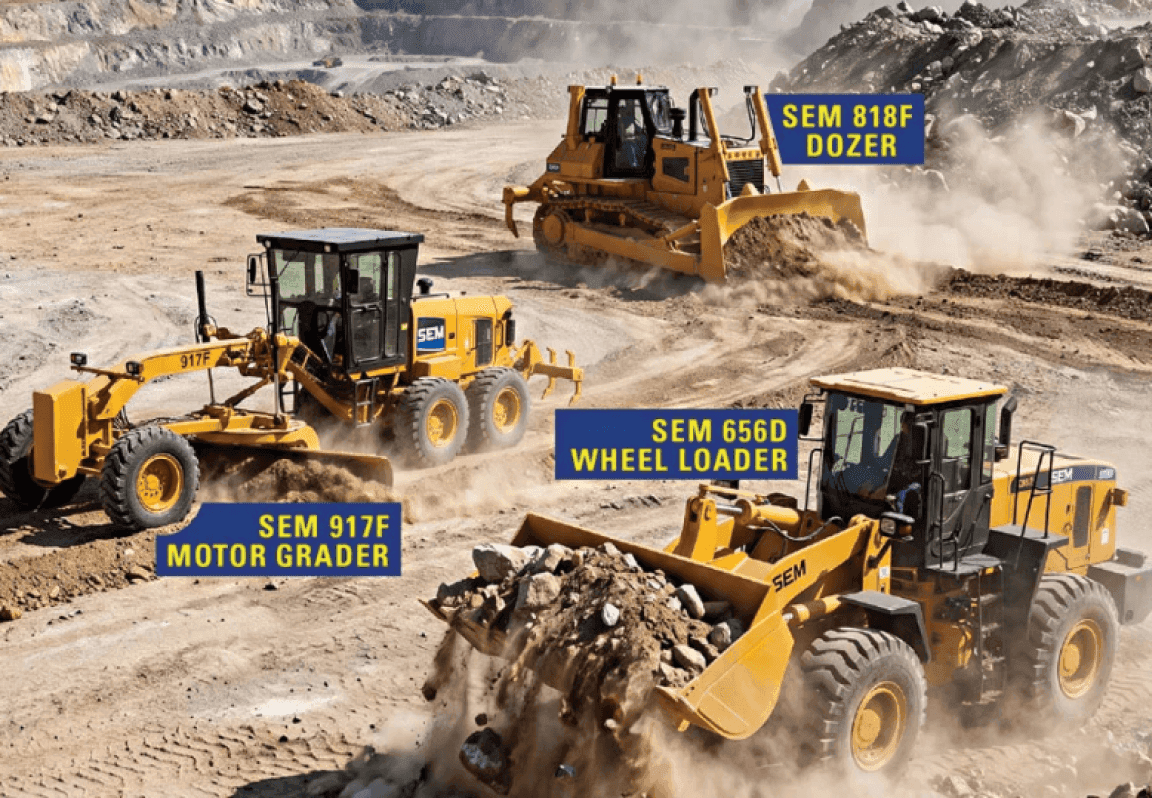
SEM’s portfolio, which includes wheel loaders, motor graders, dozers, soil compactors and wide-body trucks, addresses applications across construction, mining, road development, quarrying, agriculture and allied sectors.
Machines such as the SEM 656D Wheel Loader, SEM 917F Motor Grader and SEM 818F and 824F Dozers address different operating requirements in the Indian market.
However, the larger opportunity is not simply about having multiple products available. It is about helping customers identify which equipment is most appropriate for a particular application.
When equipment selection is driven by the job to be done rather than specifications alone, customers can move from simply purchasing machines towards creating fleets that are more productive and economically sustainable.
The meaning of affordability is also changing
Affordability is sometimes interpreted purely in terms of purchase price. But for equipment owners, the true economics of a machine emerge only over its working life.
A lower acquisition cost provides limited advantage if the equipment experiences excessive downtime, requires difficult-to-source parts, takes longer to service or fails to deliver the expected productivity.
An idle machine has consequences beyond maintenance.
It can mean lost production, project delays, underutilised manpower and ultimately a direct impact on the customer’s business.
This is why uptime and total cost of ownership need to be considered alongside the initial investment.
SEM’s lifecycle proposition includes parts, service options, customer support agreements and extended protection offerings aimed at supporting equipment availability and maintenance requirements.
But products and programmes alone are not enough. The capability of the organisation supporting the machine on the ground becomes equally important.
From selling machines to enabling customer outcomes
This is where the role of an equipment dealer is also evolving.
At GMMCO, we increasingly see our responsibility extending beyond supplying a machine. The equipment itself is only one part of the solution.
The greater value comes from understanding how that equipment fits into the customer’s operating environment and supporting it through its working life.
That means conversations around application, productivity, utilisation, uptime, maintenance, operating economics and lifecycle support.
The objective is not simply to place SEM equipment at a customer site. It is to ensure that the equipment selected is appropriate for the requirement and continues to deliver the value for which it was purchased.
For us, solution selling fundamentally means connecting equipment performance with customer business performance.
SEM brings the product proposition, engineering heritage and Caterpillar backing. GMMCO adds its understanding of Indian customer applications, operating environments and lifecycle requirements, together with the support ecosystem required to keep equipment working.
The combination enables a different kind of customer conversation.
Instead of beginning with, “What machine are you looking for?”, the more meaningful question is, “What outcome are you trying to achieve?”
That shift may appear simple, but it represents an important change in how the construction equipment industry creates value.
The next phase will belong to smarter equipment decisions
India’s continued infrastructure development will create significant demand for construction equipment. At the same time, equipment buyers are likely to become increasingly discerning about how they deploy capital.
Specifications will continue to matter. Technology will matter. Productivity will matter.
But all of these will increasingly be considered alongside utilisation, operating costs, uptime, project tenure and return on investment.
For SEM, this creates a strong opportunity to address customers seeking dependable performance while keeping a close eye on project economics.
For GMMCO, the opportunity goes further. It is about taking that equipment proposition to market through a solution-selling approach that combines application understanding, equipment selection and lifecycle support around the customer’s business requirement.
The future of construction equipment will therefore not simply be about selling more machines.
It will be about helping customers make smarter equipment choices — choices that balance capability with affordability, performance with economics, acquisition cost with lifecycle value, and most importantly, equipment performance with business outcomes.
Ultimately, the value of a machine is not determined on the day it is purchased.
It is determined every day that the machine performs, the project progresses and the customer’s business moves forward.
Originally published on
Construction Times


